 Cui
In Shipping 100+ PRs to production in a week, the author reports reaching 115 merged PRs in the week of November 9th at Imprint, a fintech. The best seven-day window was 170, of which 153 came from Imprint’s internal cloud harness, fleet, and 17 from a laptop harness. About 150 were true production PRs that continuously deployed to production (not necessarily released), and the rest were skills and internal tools.
This guide turns the article into ordered steps. The facts are from the article. Lines marked My note and every Check line are my suggestions, not the author’s, and I have not run this workflow.
The core idea
Treat AI productivity as the same development loop you already have: work, structured issues, pull requests, release. At each stage, find the current bottleneck and fix it. The article describes the bottleneck moving from missing issues, to PR quality, to slow approvals, to running out of easy work.
The workflow in motion
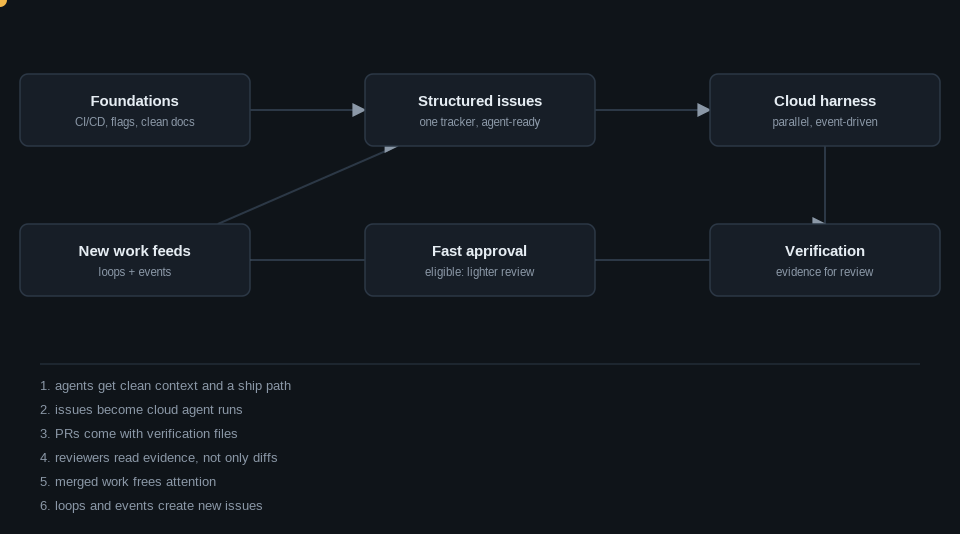
Example: my simplified loop, not the article’s chronology. The ten steps below follow the article’s order; the diagram omits step 9 (daily triage) and step 10 (hard work).
The ten steps
Step 1. Modernize deployment and release
- Do: continuous deployment (CI/CD) plus feature flags, so merging and releasing are separate.
- Check: merged work reaches production without manual release steps.
- Why first: the author says that without this, the later bottlenecks would never have been reached.
Step 2. Remove poisoned context from your knowledge base
- Do: audit RFCs and PRDs; delete or fix wrong documents. Move context into the repo where possible, for example Terraform for cloud configuration, so the agent sees the setup next to the code.
- Check: every document an agent can read is largely accurate.
- Extra: loops that update stale docs based on code changes.
Step 3. Put all work in one structured issue tracker
- Do: one tool for all issues, easy to add to from a UI, Slack and agents. Imprint moved from Jira to Linear.
- Check: an agent can pick up an issue with the context it needs.
Step 4. Run agents in the cloud, not only on laptops
- Do: build or adopt a cloud harness that is triggered by events and works when the laptop is closed.
- Why: laptop-local agents hit two limits. There were more tasks than people could track, and more grooming work than expected (merge conflicts, PR comments, CI failures).
- Check: the cloud option must beat the local one. The article names four wins: concurrency, laptop decoupling, tools available by default, and reacting to events instead of polling.
Step 5. Expose internal systems through one internal MCP
- Do: give agents the same functionality as your internal admin UI. Anyone can propose a draft change, it gets automated safety review, and approval stays with task-specific human roles that are only available through the UI, not the MCP.
- Check: agents can read values and propose updates, but every update is approved by a human with context.
- Side effect: fewer people need access to each downstream vendor tool.
Step 6. Speed up approvals, but expect a misread
-
Do: use a
small-changepath for clearly safe changes, and let some cloud-harness changes be approved by one person. - Check: about half of Imprint’s changes now go through one of these paths.
- Lesson from the article: faster approval paths helped, but the author found PR quality was the bigger bottleneck.
Step 7. Have PRs carry verification evidence
- Do: have the agent verify its work and record what it verified. Imprint adopted parts of pstack’s verification and formal verification skills.
- Check: the reviewer reads the verification files first and decides from them whether to dig into the PR.
Step 8. Feed the pipeline with new work
-
Do: once PRs get fast, you run out of easy work that was never logged. Add:
- loops that maintain verifications, review launches, check new errors and prune stabilized flags
- a software-factory loop for a well-scoped area
- event sources: static-analysis findings, new errors in logs, support-call concerns, and a
distresstool the harness itself can call
- Check: structured issues appear from loops and events. The article notes some setup and triage by a human is still needed.
Step 9. Triage your own queue with one skill
-
Do: a skill run once or twice a day,
/my-open-work. It nudges the cloud harness past failures, schedules new work, walks you through open questions, and flags the PRs that need your review. - Check: you spend less time checking status and more on open questions and reviews.
- Author’s expectation: this becomes an automatic morning process in a month or two.
Step 10. Point the speed at hard work
- Do: experiment with the Explorer pattern so teams use the new iteration speed on work that needs deep thinking about partners, members and the industry.
- Status: the author lists this as the open problem, not a solved one.
Remaining bottlenecks the author lists
- Accelerating hard work.
- Broader verification coverage, for example a reusable tool to simulate flag changes instead of one-off shims.
- Orchestration with less human involvement, such as running
/my-open-workautomatically each morning.
Where I would be careful
- Merged PRs per week asks questions, it does not answer them. The author says the same, and notes many of his PRs are simpler than those of senior engineers.
- The result is one company’s context: a six-year-old fintech with its own tooling. The article does not claim the order transfers unchanged.
- My note: the order is the lesson, not the tools. If you already have CI/CD and a clean tracker, start at the step where your actual bottleneck is, and measure it.
- The author is skeptical of “CI/CD is dead” and “code review is dead” narratives for software with heavy correctness, security and compliance needs. Best practice is moving fast and he says some of this may be wrong in the long term.
A quick self-check (my suggestion)
Ask in this order and stop at the first “no”:
- Can a change ship to production without a manual release?
- Is everything an agent can read accurate?
- Can an agent pick up an issue and run it in the background?
- Does each PR show what was verified?
- Does new work arrive from loops and events, not only from people logging it?
My note: the first “no” is probably your next bottleneck.
Source: Shipping 100+ PRs to production in a week.
Rolling out agent workflows in your team? Get in touch.
 Deep Dive: Inside Modern Web Guidance, Local Hybrid Search and Gated Retrieval for Coding Agents
Click to load Disqus comments