 Cui
Cui 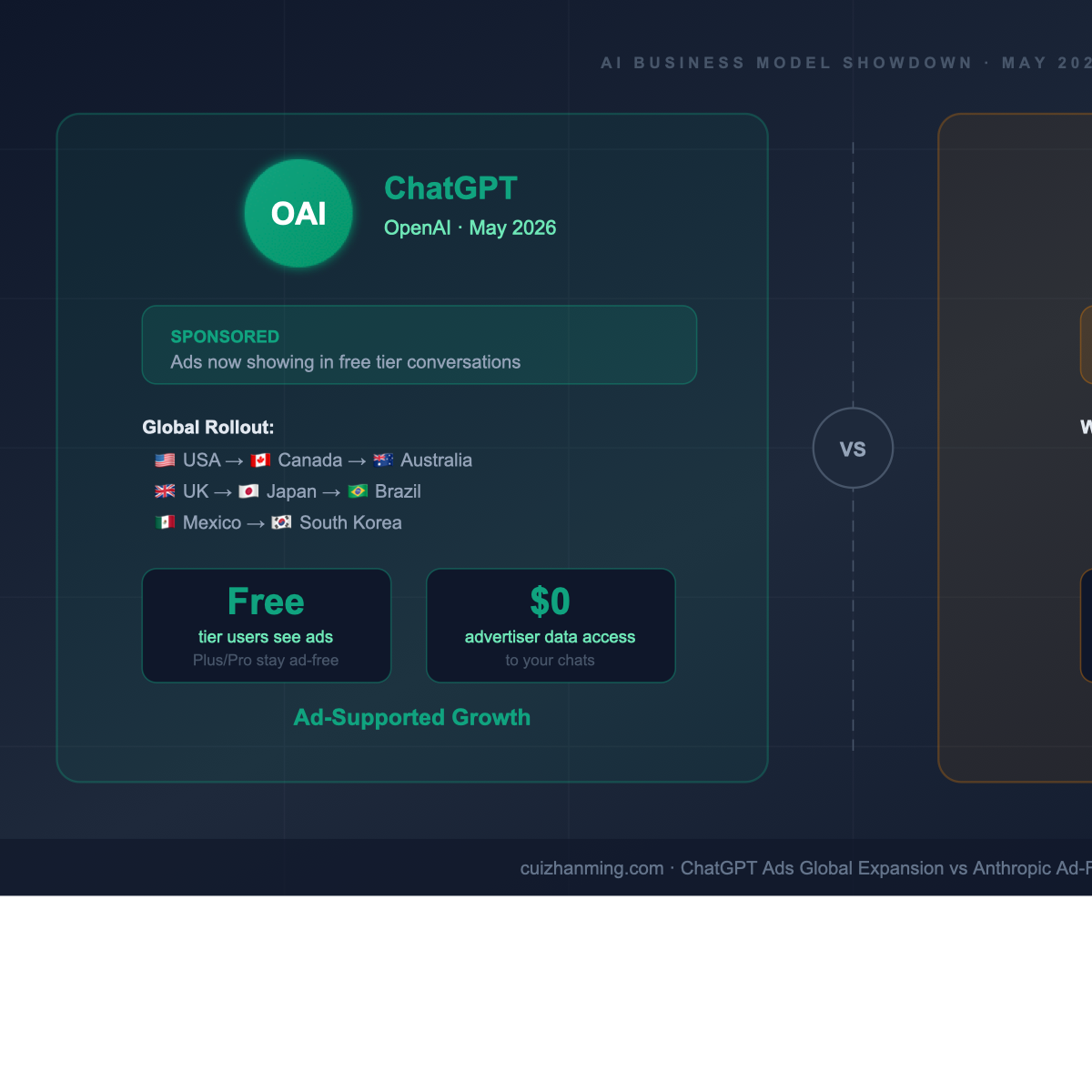
OpenAI just pushed ChatGPT ads into five new markets — the UK, Mexico, Brazil, Japan, and South Korea — while Anthropic is doubling down on a permanent ad-free Claude. These two moves, made within months of each other, define two very different bets on how AI assistants will make money at scale.
What OpenAI Is Actually Doing
ChatGPT ads started as a quiet US pilot in February 2026. The rules were simple: logged-in adult users on Free and Go tiers see sponsored content. Plus, Pro, Business, Enterprise, and Education tiers stay clean. Ads are clearly labeled, visually separated from answers, and — OpenAI insists — have zero influence on what the model actually says.
Early results apparently looked good enough to go global. March brought Canada, Australia, and New Zealand. May 7 added five more: UK, Mexico, Brazil, Japan, South Korea.
The privacy story is carefully constructed. Advertisers don’t see your chats. They get aggregate performance data only — impressions, clicks, that’s it. OpenAI targets based on conversation topic, not personal identity. Sensitive topics like health and politics are blocked from ad placement. Users can dismiss ads, check why they’re seeing one, delete ad data, or opt out entirely (in exchange for fewer free daily messages).
That last option is telling. OpenAI is explicitly running a classic freemium trade: your attention, or fewer features.
Why This Makes Sense for OpenAI
GPT-5 isn’t cheap to run. Neither was GPT-4, GPT-3, or any of the infrastructure behind hundreds of millions of monthly active users. Free tiers are a massive ongoing cost center, and subscriptions alone don’t cover the gap when most users never convert.
Advertising is the obvious fix. It worked for Google, Facebook, and every major consumer internet platform. ChatGPT already has the usage patterns that make ad targeting valuable — users are actively in problem-solving mode, exploring options, comparing products. That’s prime advertising real estate.
OpenAI is threading a careful needle: keep ads useful and relevant, not intrusive. If they pull it off, it unlocks a revenue stream that scales with user growth rather than depending entirely on subscription conversion.
Anthropic’s Counter-Move
Four days before OpenAI’s global ad expansion news, Anthropic published an essay explaining why Claude will never run ads.
The argument isn’t just ethical — it’s structural. Advertising incentivizes AI to maximize engagement over usefulness. It creates subtle pressure to keep users dependent rather than genuinely helping them. Anthropic’s position is that ad-supported AI and truly helpful AI are fundamentally incompatible goals.
Instead, Claude’s free access gets funded through cross-subsidization from Claude’s API revenue (enterprise contracts) and paid consumer tiers. The bet is that a trustworthy, genuinely useful AI is worth paying for — and that users who need power will pay, making free access sustainable without ads.
This is also a product differentiation play. “Claude doesn’t have ads” is a meaningful statement when ChatGPT does. For privacy-conscious users, for healthcare workers, for anyone doing sensitive research — the ad-free positioning matters.
Two Models, Two Philosophies
| Dimension | OpenAI (ChatGPT) | Anthropic (Claude) |
|---|---|---|
| Free tier funding | Advertising | API/enterprise cross-subsidy |
| User data use | Conversation topic targeting | None for ads |
| Opt-out | Yes (fewer messages) | N/A (no ads) |
| Differentiation | Feature tiers (Plus/Pro stay clean) | Ad-free as a core promise |
| Scale bet | Ads scale with MAU growth | Enterprise/API revenue scales |
Neither model is obviously wrong. OpenAI’s ad approach is the more proven path — it’s how most consumer internet scaled. Anthropic’s approach bets on enterprise and power users being willing to pay premium for a clean, trusted experience.
What This Means for Developers and Teams
If you’re building on top of ChatGPT APIs — you’re fine. API access is enterprise-tier and never sees ads. Same with Business and Enterprise ChatGPT licenses.
If you’re recommending AI tools to non-technical users or clients who’ll be on free tiers, the experience is now diverging. ChatGPT free users will see ads. Claude free users won’t.
For internal tooling and anything touching sensitive data, Anthropic’s privacy framing (no ad targeting, no data sharing with advertisers) is going to matter more in compliance conversations.
The Bigger Picture
What both moves signal: the era of “we’ll figure out monetization later” is over for AI products. The two largest AI labs are now making explicit choices about how to sustain free access at scale.
OpenAI is betting that advertising + subscriptions can coexist if the ads are high quality and the privacy story holds. Anthropic is betting that the users who matter most will pay — or their enterprise contracts will cover the gap.
Watch which model attracts higher-value users over the next 12 months. That’ll tell you which bet aged better.
OpenAI’s global ad rollout is available at openai.com/advertisers. Anthropic’s ad-free stance is outlined in their February 2026 post “Claude is a space to think.”
 LLMs Corrupt Your Documents When You Delegate: What the DELEGATE-52 Benchmark Reveals
Click to load Disqus comments