 Cui
Cui 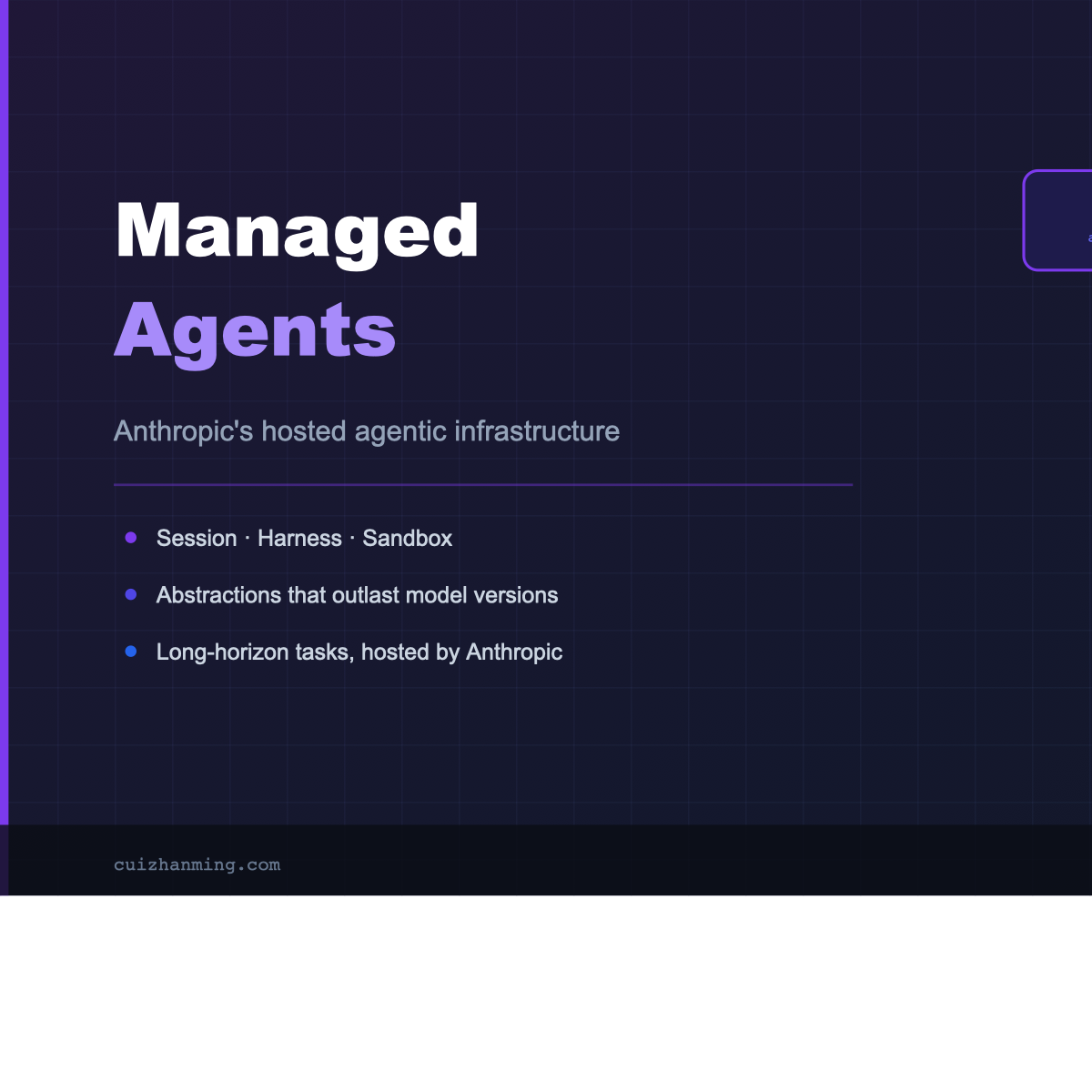
Anthropic just shipped something that feels quietly significant: Managed Agents, a hosted service that runs long-horizon AI agents on your behalf. Not a model upgrade. Not a new benchmark. An infrastructure primitive — and that distinction matters.
The framing Anthropic chose is telling. They compare it to how operating systems solved hardware abstraction. The read() syscall has survived 50 years of storage technology because the abstraction was right, not because the underlying hardware stayed the same. Managed Agents is betting that session, harness, and sandbox are the right abstractions for the agentic era.
The Three Primitives
Each Managed Agent exposes three components:
- Session — an append-only log of everything that happened. Think of it as the agent’s working memory and audit trail rolled into one.
- Harness — the loop that calls Claude and routes its tool outputs to the right infrastructure. This is where the “keep-Claude-on-task” logic lives.
- Sandbox — an isolated environment where Claude can execute code, read and write files, and take actions.
What makes this interesting is that each component can evolve independently. Anthropic can swap the sandbox implementation without touching your session history. They can improve the harness loop without changing the API surface you call.
Why This Architecture Now
There’s a real engineering problem hiding behind this announcement. Anyone who has built a production agent knows the pain: you tune behavior for Claude 3, ship it, then Claude 4 arrives and the workarounds you built start working against you.
Anthropic’s blog post is honest about this. They noticed that Claude Sonnet 4.5 would abandon tasks as it approached its context limit — a behavior they called “context anxiety.” They patched it in the harness with context resets. Then Claude Opus 4.5 shipped and the anxiety was gone. The resets became dead weight, silently hurting performance.
Managed Agents is designed to make this class of problem visible and fixable at the infrastructure level rather than buried in every customer’s bespoke harness code.
What Changes for Developers
If you’re building on the Claude API today, the shift looks roughly like this:
Before: You write a loop, manage state yourself, handle retries, build a sandbox, and pray your assumptions about model behavior don’t go stale after the next model release.
After: You call a Managed Agents endpoint, pass in a task, and get back a session ID. Anthropic’s infrastructure owns the loop, the state, and the execution environment. Your code stays thin.
The tradeoff is real though. You give up fine-grained control over the harness in exchange for Anthropic maintaining it. For teams where agent reliability is the bottleneck, that’s a good trade. For teams doing novel research or needing unusual tool routing, it may not be.
The Bigger Picture
Anthropic’s run-rate revenue crossed $30 billion recently — up from $9 billion at the end of 2025. That growth didn’t come from consumers. It came from enterprise and developer customers running Claude in production pipelines. Managed Agents is infrastructure for exactly that audience.
The compute announcement with Google and Broadcom (multiple gigawatts of TPU capacity coming online in 2027) is the backstory here. You don’t build a hosted agent execution service without believing you’ll have the compute headroom to run it at scale.
The OS analogy isn’t just marketing copy. It’s a design principle: build abstractions that outlast any particular model. If that bet pays off, the session/harness/sandbox interface could become as stable as the POSIX syscall table — the thing developers build on without thinking about what’s underneath.
That’s a bold claim. But the underlying logic is sound.
🔗 Read the full article: https://cuizhanming.com/anthropic-managed-agents-hosted-agentic-service/

Click to load Disqus comments